Sunday, June 20, 2010

BUSY GIRLS IN THE UK UPTO JUNE 2010

Hello everyone,we have been busy keeping in touch with each other. The UK is a good place to meet and catch up on our friendships, don't you agree?
Here are some of the things we have been up to.


QAMAR MEETS DR. MARY ARCHER
THE OLD VICARAGE IN
GRANCHESTER WHERE RUPERT BROOKE LIVED FOR A WHILE AND WROTE ABOUT IN HIS POEMS


THE POET RUPERT BROOKE
We've all read poems by Rupert Brooke for Senior Cambridge. Qamar lives near this Vicarage which is the present home of the author Jeffrey Archer and his wife Mary.
An event was arranged where she read and explained the famous poem "THE OLD VICARAGE,GRANTCHESTER".
Many of us had to read this poem for our finals. Hearing it again through the words and emotions of one who now lives there brought on a fresh outlook and of course nostalgic feelings!


RITA ROY (batch of 1970) has been singing in India for a while now.
She was in the UK on tour.

Her programme was entitled
Melodies & The Magic of the River a magical evening performed to packed audiences, at the Rudolf Steiner Hall on 22nd May, 2010, and on 8th June, 2010, at The Nehru Centre. The first programme consisted of Hindi film songs covering 6 decades (1950 to the present day ) in which memories were rekindled by singing some of the most memorable melodies produced in Bollywood.
Rita's singing was accompanied by Sujit Sil and Rekha , who are singers of repute in London.They were also backed by live musicians one of whom was the well known Mohamed Kassam who has played for Lata Mangeshkar and played in many songs for Raj Kapoor.
We were entertained by songs such as "Tere mere sapne" from Guide, "Raina beeti jaye" from Amar Prem and songs from films like Umrao Jaan and Parineeta.
The second event, held at The Nehru Center, London, was a solo performance by Rita in which she traced the various moods of the rivers in India -the Ganga, the Brahmaputra, the Jamuna - sung in Bengali, Assamese and Hindi, linked together by a narration in English read by Pritha and her son Agnish. Here too she was accompanied by live music. Popular songs like O Nodire. Ganga Aye Kahan Se, Ganga Amar Ma and Ganga Behti Ho Kyun were included in this presentation.

Mohamed Kassam


BIJOYA SAWIAN'S VISIT


When Bijoya Sawian was here she met up with Naila Kabeer, Rita Payne and Verity Whitworth. They had a wonderful day together as you can see.......


Rita's husband Geoff joined them too.


Bijoya has just published her first book. Here is a review in THE TELEGRAPH in Kolkata


Today's Edition
Wednesday , April 28 , 2010
THE TELEGRAPH

Cathartic twist to pastoral whodunit- Shillongite in novel debut after Oxford stint
SUDIPTA BHATTACHARJEE

Sawian in traditional attire at Christ Church, Oxford


He was a clean-cut kid,
But they made a killer out of him
-Bob Dylan
Calcutta, April 27: It is a steep descent from the bustling Guwahati-Shillong Road at Mawprem to Lower Mawprem, past the house of former Meghalaya chief minister E.K. Mawlong, to a pair of stately gates marked Lakyrsiew. Inside, the pear-tree lined drive to the picture-postcard setting of the Sawian homestead is matched by the graciousness of its occupants.
The eldest daughter of the house, Bijoya Sawian, was born here in 1950. Recently back from Oxford University where she did a course in creative writing, Sawian’s maiden novel, tentatively titled Shadow Men, is ready for publication.
What, you wonder, could have inspired (Sawian prefers to call it ‘provoked’) a novel with a darkened chiaroscuro when the pinecones in the hearth are popping with such warmth? “A turbulent August in Shillong almost a decade ago sowed the idea of the book,” she says. “The sadness I felt when I thought of all those young people out there, with few or no alternatives beyond these hills because of their circumstances, suddenly poured out in a huge torrent of words. I suppose it was a kind of catharsis for me”.
That Shillong would comprise the pivot of her story is but natural since Sawian is proud of her cultural identity. “My siblings and I grew up in our maternal grandmother’s house and were brought up strictly according to the precepts of the Khasi religion, culture and tradition,” she explains. “The issues in my book were staring me in the face: the erosion of values, matriliny, the horrific corruption in politics, the despair and angst all around, and of course, the few unsullied souls that still exist to remind us that there is hope, all is not lost.…”
Shadow Men does not offer solutions, or even seek to do so, says Sawian. She has been nurtured in a matrilineal society, where the mama (maternal uncle) takes decisions and the youngest sister, khatduh, is the custodian of ancestral property. To the outside world, matriliny projects the rosy hues of emancipation and empowerment of women. That it brings its share of responsibilities and burdens often goes unstated.
In her manuscript, Sawian weaves these perplexities in the form of a conversation between the protagonist and her driver, Robert.
For Sawian, who comes of mixed parentage, this realisation is tinged with a sense of verisimilitude. Her father came from a Hindu family that migrated from Sylhet to the hills in 1927. “My mother was Khasi; her family resisted the wave of conversion that swept our hills in the 1840s and to this day professes the original religion of the Hynniewtrep, Niam Khasi Niam Trai. When we — three sisters and two brothers — were young, my father, an immensely intelligent and farsighted man who retired as the last IGP of undivided Assam, made a decision that made all the difference in our lives.
He felt that since he was not in his own land but that of his wife’s where the religion, culture and tradition were not only alive and vibrant but had already made a considerable impact on our lives, we should not be introduced into yet another culture. He realised with all his wisdom that if we were forced to be ‘neither here nor there’ we would suffer an identity crisis.”
This sense of belonging is evident in the pages seeped with nostalgia. “What on earth had I got myself into? Is this the summer of madness that Aila and I had planned over telephonic giggles? Innocent plans to relive our childhood strolls through pine-scented forests and along quiet lakes full of secrets, to rest our eyes on emerald hills that roll on and on in the distance to touch a sapphire sky. Maybe we focused too much on the word ‘madness’ and now it was exactly that that was happening.
Next morning I woke early and switched on Radio Shillong. I lay in bed for a while listening to the melodious Khasi songs sung by the beautiful Kong Helen Giri. The music transported me to a faraway land where Man and Nature merged in perfect melody…”
Or, “I passed the erstwhile Polo Grounds, now a huge stadium for soccer and hockey. An eyesore if one compared it to what it was, a beautifully kept patch of emerald green turf for the races, encircled by wooden stiles. During my girlhood days I used to love coming to the races because my mother would be at her sunniest best, laughing and betting with her Khasi friends. My father did not know of this delicious, surreptitious indulgence of hers…”
Will the novel, highlighting as it does corruption, militancy and questions on a centuries-old social structure not ruffle feathers? The feisty sexagenarian is banking on the “universality” of her theme to get the readers thinking about the myriad unanswered questions. And being a Shillongite to the core, she signs off with a poignant salute to Bob Dylan:
“Everyone wants to know why he couldn’t adjust
Adjust to what – a dream that bust?”

Tuesday, April 13, 2010

Dinner at The Red Fort London 3rd April 2010

We met at the Akbar Bar at 6 pm


Naila Kabeer, Noyon Linnebank, Lorna Bang and Rekha Mirchandani


We invited our spouses this time, so here are some
Depak Mirchandani with Ritu Kataky and Noyon


Moina Rizvi with Qamar Nizam

Next to Qamar are Bipul Kataky and Geert Linnebank


We didn't always look away.....


There was a lot of affection too!


Rita Payne with Arif Rizvi and Rafique Nizam


Congratulations to Lorna Bang and Padraig Lyons on their forthcoming wedding in October......where else but in Shillong!!


Lorna,Rekha, Joya Das and Naila


Noyon, Virginia Landon and Padraig


A most enjoyable evening. We plan to have more with the husbands.
Before putting this historic event behind us, I just wanted to share a poem that Naila received on the occasion of her last birthday, another birthday she made a big deal of. "I rememebered it when I decided to write this thank you note and found it has a message for all generations of women", said Naila.
THE AGES OF WOMEN
AGE 8: Looks at herself and sees Cindarella/Sleeping Beauty.
AGE 15: Looks at herself and sees Cindarella/Sleeping Beauty/Cheerleader Or if she is PMS'ing: sees Pimples/UGLY ('Mum, I cant go to school looking like this!')
AGE 20: Looks at herself and sees: "too fat/too thin; too short/too tall; too straight/too curly" But decides she's going out anyway
AGE 30: Looks at herself and sees: "too fat/too thin; too short/too tall; too straight/too curly" But decides she does'nt have time to fix it so.. She's going out anyway.
AGE 40: Looks at herself and sees> "too fat/too thin; too short/too tall; too straight/too curly" But says, "At least I'm clean" and goes out anyway.
AGE 50: Looks at herself and sees "I am" And goes wherever she wants.
AGE 60: Looks at herself and reminds herself of all the people who can't even see themselves in the mirror anymore> ...she goes out and conquers the world.
AGE 70: Looks at herself and sees Wisdom, laughter and ability, Goes out and enjoys life.
AGE 80: Doesnt bother to look, Just puts on a red hat and goes out To participate in the world.
AGE 90: Can't see and doesnt worry about it!!!....probably goes out anyway!!


Friday, November 20, 2009

Dinner at the Blue Elephant, London. 8th November 2009

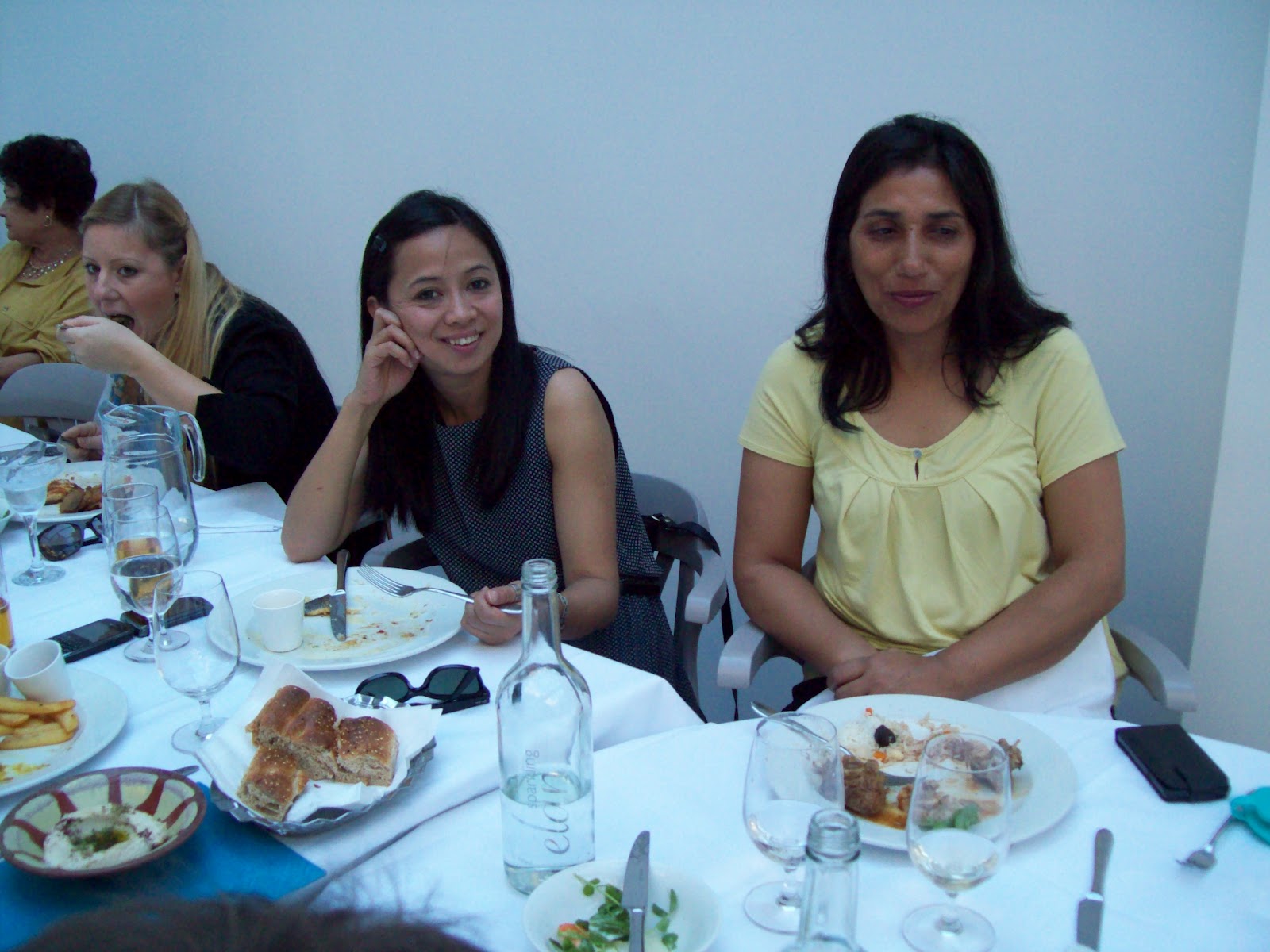
It was a wonderful evening. We were seated in a room surrounded with glass....very thoughtful of The Blue Elephant staff, especially as we felt free to talk and laugh without disturbing our neighbours!! That's exactly what we needed to "let our hair down" and go back to where we belong...Hail Loreto


The surroundings were gorgeous, as if we were in Thailand with waterfalls,riverlets, fish and even a boat.


Joya and Qamar enjoying a joke. I think we laughed most of the evening!


Here we can see Naila, Verity, Jinnie and Rita


Rekha with our newest and youngest member so far, Larimon


Ameerah, Joya and Qamar


Naila, Verity and Jinnie


Larimon and aunt Nayontara. Two generations of Loretoites


Ritu and Ameerah


Some messages


It was a wonderful evening. Loved meeting the other loretoites who are in the Uk.keep up the good work Qamar.Looking forward to another meet at another venue!Joya


Hi,Once again...enjoyed being with you all. Any possibility of seeing Verity dance? That would be such fun!! Thanks Qamar ...great job.Ritu


Meeting all the 'seniors' was great and it never ceases to amaze me how all Loreto girls can identify with each other so easily.
Many thanks again
See you all soon
Nayantara

It was great to catch up with everyone again.Best,Rita

Friday, November 6, 2009

A beautiful message from Ameenah 2nd November 2009


Dear Loreto Girls,

It's great these reunions are happening in London.I still cannot get over our memorable trip to Shillong for the Centenary celebration of our dear school.As we are gradually closing our files of active participation in life from career,family,business, professional life it's great we can reunite with our school friends .As we are reaching an age where we can put up our feet and relax at home and enjoy grandchildren nothing could be better than uniting with Loreto Shillong girls we met in childhood in our grey uniformws and red cardigans.Qamar is doing an excellent job in London. I hope we remember our aim to meet in Delhi next year. It would be good to set a date and inform Iabella. After that we can set a date for London again for 2011 specially our group of 1955-63 Loreto Shillong.If we start working now we can meet definitely.Have a great dinner at the Blue Elephant. I have yet to see one!!! Ameenah Ahmed

Wednesday, October 14, 2009

Alakananda Mookerjee


ABOUT AN ALBUM OF THOUGHTS
From ALAKANANDA MOOKERJEE:

A view from Shillong Peak


An Album Of Thoughts is exactly what it sounds like. It’s a collection of thoughts and photos (like in a traditional album.) It’s an assortment of scribbles on everything from an afternoon spent in the kitchen, stirring a pot of tangy Indian curry, to my thoughts on interplanetary travel. Isn't that an eclectic mix? I hoisted this blog as a struggling student in grad school, a few years ago, but never quite nourished it. Sometime in early 2009, I rescued it from oblivion. It’s here now. I don’t recall the exact date, but sometime after I’d fed (and somewhat fattened) the “Inside Pages” I invited Sharmila Mukherjee (my closest friend) to be a scribe, and help me with pumping more content here. For a day job, I work as a journalist. In the event that you're interested in leafing through my clips, please ask me for the keys to my journalism closet.


My article on Shillong (my birthplace) appeared as the cover story in the August 2009 issue of the Indian-American (print) magazine Khabar. It is reproduced below:
According to a recent UNESCO report, “Atlas of the World's Languages in Danger of Disappearing,” India tops the list of nations with the most number of dialects on the brink of extinction—as many as 196.Khasi is one of them.This is the language spoken by about one million people in the Northeastern Indian state of Meghalaya. It is also the name of one of the three dominant tribes that call this hill province their home, the other two being Jaintia and Garo.The UNESCO publication is an overview of the world’s cultural indicators. Its eye-opening maps, compelling charts, and sobering statistics, must come as a wake-up call to all linguistic groups, hitherto unaware of the rapid erosion of their native tongues.Mine, is not one of the languages on that list. Yet I can’t help feeling chagrined because of the fact that Khasi—is. The reason? I am almost Khasi, but not quite.Hypothetically, I could answer the question, “Where are you from?” in two ways, depending on which cultural norm I subscribed to. If I were to identify myself with my parentage (Bengali Brahmin, in my case) and the language I grew up speaking at home—as is the practice in India—I would have to say that I hail from West Bengal. Were I to lean the "Western" way, however, and forge an identity on the basis of my birthplace, I would have to declare that I am Khasi.So it’s not an inaccuracy to say that my roots are in Meghalaya.
The Abode Of The CloudsThe word Meghalaya translates literally as “The Abode of the Clouds” in Sanskrit. And this is not without a reason. Cherrapunjee (now Sohra), located roughly 35 miles from the state capital, Shillong, is reputed to be the world’s wettest place, receiving an annual rainfall of around 470 inches a year. The effects of this heavy precipitation are felt in its immediate vicinity. It doesn’t matter what season it is, the clouds are a near-permanent fixture of the state’s geography.Come (most) afternoons and you’d see a slow-moving convoy of pillow-like, whitish-grey clouds scudding across the horizon. Post-noon, as if prompted by a celestial clock, they would emerge out of hiding, play peek-a-boo for a varying length of time, until they settled down snugly over the hilltops, draping them in a blanket of dense, milky fog.In 1979, when neighboring Assam was rocked by the so-called "anti-foreigner’s agitation"—a student-led movement directed against its economically-dominant Bengali-speaking residents and illegal immigrants from Bangladesh—Meghalaya too, felt its repercussions. Between then, and the late 1980s, another, and a far darker "cloud" also hovered on the sky—that of political turmoil and social unrest.But the Meghalaya I know, and remember is one that wasn’t polluted by the black carbon trail from cars, trucks, buses, wasn’t marred by insurgency and wasn’t hit by global climate change. In my memories, the time spent there are the most carefree of days, filled with sunshine and warmth.
The Land
In terms of its administrative structure and its political fabric—barring minor variations—Meghalaya is similar to the rest of the country. But culturally speaking, it stands in a league of its own. Its people have a distinct "Englishness" about them, a trait that permeates nearly every aspect of its society—from the architecture of its buildings to its school system to its peoples’ love affair with Western music. The climate, the flora and the topography of the land also blend in harmoniously to reinforce its reputation as a "Westernized" outpost on the outer fringes of India. Summers are pleasant. Winters are cold to chilly.With 42 percent of the state covered by forests, it is hardly surprising that most parts of Meghalaya are woodsy. Gurgling streams, dancing waterfalls and grassy downs dot the terrain. Vibrant flowers (including 325 species of orchids) abound, and the air is always saturated with the captivating scent of pine. Little wonder that it was christened “The Scotland of the East” by the British colonizers.Perched on a plateau nearly 1,500 meters high, Shillong (population: 260,000) is surrounded by several low hills, three of which are revered by the Khasi—Lum Sohpetbneng, Lum Diengiei and Lum Shillong. The city itself is named after the tribal deity, Shyllong.
The TownBack when I was growing up there, no building in Shillong had more than five floors. There weren’t any neon-lit signs that spelled the names of big businesses and global brands. The state had its share (albeit small) of industry and commerce. But life, on the whole, wasn’t commercialized. Goods were highly affordable. One didn’t have to sweat over making money. Day-to-day living was struggle-free and hence, enjoyable.Shillong’s downtown, curiously named Police Bazaar was where the action was. Congested, compared with the rest of the town, it was the local version of New York City’s Times Square and Fifth Avenue rolled into one, in the sense that it was the port of entry for tourists who arrived in buses as well the prime shopping hub for everything from groceries to clothing. This is also where Shillong’s handful of "cinema halls" and restaurants were clustered.Packed into Mawprem’s (a locality in Shillong) chaotic jumble of shops was the nondescript store, “Mahari & Sons,” one of the oldest bakeries in the area, reputed to have supplied breads to the British army in the 1930s. A destination for epicureans, its look and location, I always felt, was incongruous with its gourmet image.
One of its specialties, the "chicken patty"—a fluffy, pastry dough stuffed with a filling of finely mined and delicately seasoned chicken—was a special treat I got from my parents, every so often, for nothing in particular. At a time in India, when meat enjoyed the status of caviar among large sections of the population, “Mahari & Sons” sold well-cured sausages and salami, whose taste, still lingers in my taste buds. Today, it has expanded into a supermarket.
Going To School
The roads were skinny. Luckily, they didn’t have to bear the burden of heavy traffic. Flanked on either side by an archway of foliage that created the impression of a Gothic vaulted-ceiling, they would leisurely wind up the contours of verdant mountains. Quaint little houses, with smoke curling up their chimneys, would peek out through gaps in the shrubbery lined-fences.At the end of a steep road, there stood a lovely, elongated, two-storied building. A metallic gate that opened into a sun-lit, concrete courtyard, of sorts, ushered one into a serene, I-shaped corridor. At its far end, was a wooden, three-legged table, covered with white linen, where sat an old-fashioned school bell, always at the ready, ever prepared to be hefted from its station by a redoubtable Irish nun and tolled sonorously. Girls in perfectly-starched white shirts and grey pinafores (or skirts) and blazers would then, shuffle in their seats, awaiting the start of the next class or file out of their classrooms—as noiselessly as possible—and proceed to their next activity—physical exercise, singing, dancing or art lessons.This was the milieu in Loreto Convent, Shillong—Meghalaya’s finest academic institution for young women. Opened in 1909, the school celebrated its centenary celebrations, earlier in May. Along with an emphasis on academic excellence, it also focused considerable attention on the social grooming of its students, much like a European “finishing school.” We, the Loreto girls, even as five-year-olds, knew it was bad manners to eat with our mouths open. We said "thank you" to anyone who offered us help or a gift. We tried to be, almost always, on time. We also bowed and curtseyed like the von Trapp family children in "The Sound of Music."Shillong has enjoyed a formidable reputation for its K-12 set-up. Its convents—both for girls and for boys—were regarded as some of the best in the nation, for their strict discipline and the exemplary set of values they inculcated.
At Home
I led a cloistered life. When I wasn’t at school, I was "home, sweet home." The physical house in which I lived was just as delightful. It was as pretty as a picture-postcard. The structure of most independent bungalows in Meghalaya was nearly identical. They were invariably all wooden, with sloping tiled roofs, a patch of well-manicured lawn, a chimney and a driveway. The government-provided residences, reserved for the states’ politicians, judges and administrators—members of the elite Indian Administrative Service (IAS)—were the grandest in town, though most others were not unattractive.“Ekanth Cottage,” the mansion in which I grew up was a spacious five-roomed mansion that sat atop a little hillock, overlooking the Shillong racecourse—called the Polo Grounds—and the local golf course. Spread out across a vast, pinecone-sprinkled compound, it was framed on one side by a semi-circle of tall, coniferous trees. The other, offered an uninterrupted vista of the valley below, which rose to meet the lush, rolling hills on the opposite horizon.Those of modest means did not reside in commodious, colonial-style manors. If their homes fell short on floor-space and grandeur, they certainly made up for that through ample rustic charm. Apparently simple articles such as a flower vase, a set of red and white checkered curtain, a wooden cross hanging above the mantelpiece or a faded area-rug, imparted coziness and conveyed a wonderful sense of gracious hospitality. A distinctive feature of the tribal households, and especially those of the Khasis, was its squeaky-cleanliness, which often manifested in the degree of luster of their shining hardwood floors.
The PeopleThe people of Meghalaya are gentle, courteous and soft-spoken. They are a hardworking lot, without being brazenly ambitious. Which is why, it was rare to see a Khasi, a Garo, or a Jaintia pursue a career in engineering, medicine, academia, law, or the civil services. The higher echelons of the bureaucracy were comprised of men (there were very few women then) who were born in the rest of India. These officials served in Meghalaya neither because they harbored hegemonic aspirations nor had they any interest in subjugating the locals. They were selected to do what they did, by an impersonal entity called the “Civil Services Examination.”Unlike in most parts of India, where the male child gets preferential treatment, Meghalaya’s tribal society is matrilineal, a system that grants special status to girls. The youngest daughter of the family inherits all family property and is entrusted with caring for the elders and unmarried siblings.The people of Meghalaya are very musically-inclined, to a particular kind that is— to rock, funk, and blues. According to Shillong residents, nearly one out of every four people there either sings or plays a musical instrument. One of the reasons a road trip through Meghalaya won’t feel like you’re in India is that you won’t hear Bollywood music blaring from loudspeakers. You would hear a snatch of a hymn, wafting out of an open church door or a deep male voice (with shades of Elvis Presley), singing “Love Me Tender” to the strumming of a guitar on a balcony. Unsurprisingly, Shillong has earned a new moniker today—“Rock Music Capital of India.”In a New York Times article on Shillong, Somini Sengupta writes:
Many theories are offered for Shillong’s fascination with rock and the blues. Some argue that the area’s indigenous Khasi traditions are deeply rooted in song and rhyme. Some credit the 19th-century Christian missionaries who came from Britain and the United States, introduced the English language, hymns and gospel music and in turn made the heart ripe for rock. Some say the northeast, remote and in many pockets, gripped by anti-Indian separatist movements, has not been as saturated by Hindi film music as the rest of India. Others speak of that ephemeral quality of rock ’n’ roll, able to seep into young, restless bones anywhere.Each time I think of Shillong, a face floats before my eyes: Irene was a white-haired lady who sat in the foyer of Loreto Convent, a sweet person in a sweet place. It’s time to go back to visit.

Thursday, July 23, 2009

recent messages from you.


Dear Qamar,
Thank you so much for your lovely pictures, write-up, etc, on your Blog. You really seem to have captured every moment of not just the Loreto Centenary, the ex-students but everything that is Shillong!I am very happy to know that you and your sisters, friends, et all, had a wonderful time at Shillong & the Heritage and are still doing so.Good luck with all future L.C Reunion's, dinners & parties! I hope I can visit you one day and re-live those days again.
Lots of love to all of you- Qamar, Ameenah, Ameerah,Taheerah & Naila. I learnt a lot by interacting with you and never felt that there is a 20 year 'school- leaving' gap between us(please do excuse me...!)! Just goes to show that LORETO Students are the same everywhere- loving and caring, often daring, ethical and ever-green!
Cheers!
Pragya Deb Burman,(Loreto Convent Shillong-Yr 1987)